
How a chilled water plant that satisfied every setpoint it reported was starving the galleries above it — and how continuous commissioning found the reason and proved it in a single afternoon.
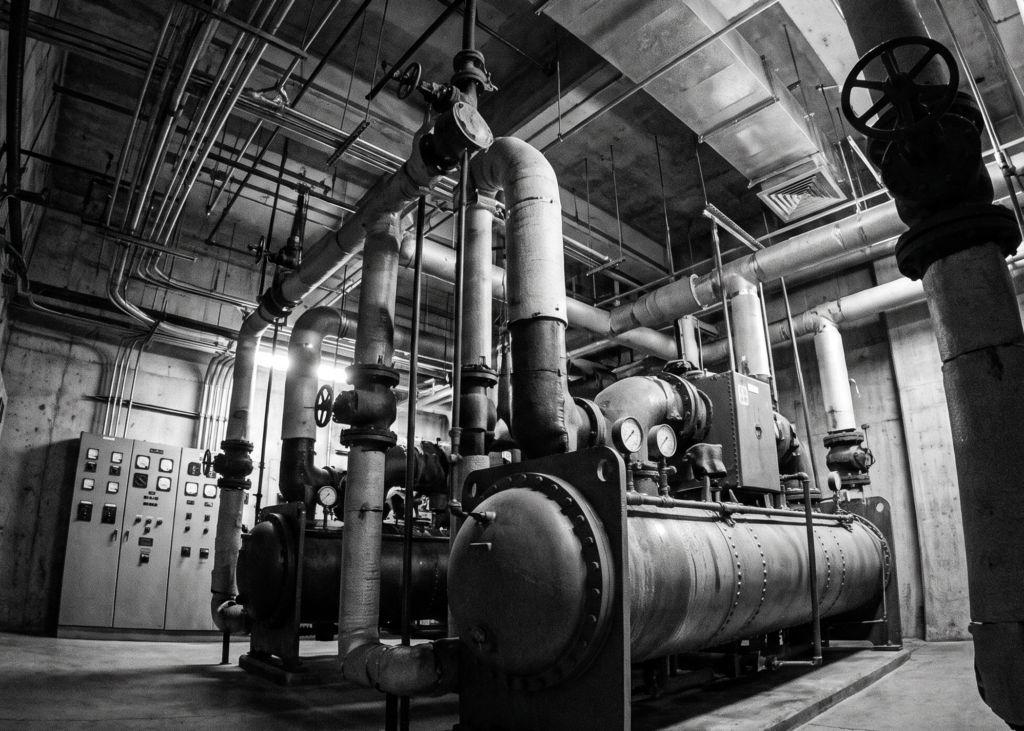
THE SITUATION
Gallery zones sat outside Class A and Class B tolerance. The air handlers serving them had their cooling coils pegged at 100 % and still could not dehumidify. Meanwhile every plant setpoint operations could see was being met: leaving chilled water temperature, hot water temperature, and both differential pressures.
That is the hardest kind of failure to act on. Nothing was in alarm and nothing looked wrong. The plant was reporting success while the building it served was failing.
Class A and Class B rated spaces, both outside band.
CHW temperature, HW temperature and both DPs.
A healthy-looking plant and a failing building.
None of these would ever surface in a setpoint-conformance check — which is exactly why they ran for as long as they did.
Circulation was blocked Trapped air blocked risers and held flow near 150 GPM against a 299 GPM coil demand.
Water passed through a chiller that was off Return water blended back through the disabled machine, raising chiller 1’s leaving temperature.
The DP reading was physically meaningless Air is compressible. The false pressure it produced read as a perfectly satisfied setpoint.
The equipment was already telling us
Chiller 1 in alarm
Boiler 1 in alarm
FAILURE DOMAIN 01
Circulation was blocked, not demand
Chilled water flow from chiller 1 sat essentially constant near 150 GPM while every downstream cooling coil was wide open. The manufacturer rates this machine between 100 and 385 GPM, and AHU1, AHU2 and AHU3 together call for 299 GPM at full coil position — so the plant had more than double the capacity it was actually delivering. Flow was not responding to demand because it could not. Air trapped in the loop was blocking circulation and blocking risers outright, and the pressure that blockage created was being read downstream as a system that had already reached its setpoint.
FAILURE MODES
Bottom line: the plant could not deliver flow
Water passed through a chiller that was off
Chiller 2’s leaving chilled water temperature tracked chiller 1’s closely even when chiller 2 was commanded off — which is only possible if water is still moving through it. The modulating valve was open on a disabled machine, so supply water was passing through an idle evaporator and picking up heat on the way. That alone accounts for chiller 1 producing chilled water warmer than the mechanical documents specify. The sequence of operations limits leaving chilled water to 44–50 °F; the plant was running above 50 °F, and chiller 2 dropped as low as 40 °F.
FAILURE MODES
Bottom line: an idle chiller warmed the supply
FAILURE DOMAIN 03
The DP reading was physically meaningless
Differential pressure was the one metric operations had that said the plant was healthy — and it was the metric the fault was hiding behind. Air is compressible; water is not. With air in the loop, the DP sensor was reporting a pressure that had little to do with the flow actually reaching the coils, and the blocked risers raised loop pressure enough for DP to satisfy its setpoint at roughly half the required flow. A conformance check comparing measured values to setpoints would have passed this plant every single day of the fault.
FAILURE MODES
Bottom line: a met setpoint is not health
FAILURE DOMAIN 04
The equipment was already telling us
Chiller 1 raised S1_ALARM with S1_FLT_CODE reporting fault 7, and was still in alarm when the plant was reviewed, by then reporting code 26. Boiler 1 went into alarm and logged no reason at all. Neither alarm changed anything about how the building was operated. In a facility whose galleries depend on the plant holding tolerance continuously, an alarm that sits unread for four months is indistinguishable from no alarm at all.
FAILURE MODES
Bottom line: unread alarms are not alarms
THE SOLUTION
Verify what the plant actually delivers — not only what it reports about itself.
Flow, leaving-water temperature and downstream coil demand are checked against each other and against the manufacturer’s operating envelope — never against a setpoint in isolation.
Isolation and modulating valve state is verified against chiller enable status, so an idle machine cannot quietly blend heat back into the supply.
Pressure, flow and temperature are cross-checked for physical consistency, so an instrument reporting a comfortable number cannot mask the system behind it.
Chiller and boiler fault codes are surfaced continuously with their meaning attached, and carried into a work order instead of ageing in the front end.
ROOT-CAUSE ISOLATION
The hypothesis was hydraulic, not thermal. It was tested against the plant before any repair was committed to.
Chiller 2 was enabled. Flow doubled and leaving chilled water temperature fell further — confirming the plant held capacity it was not delivering.
Air was bled from the chilled water system. Flow from chiller 1 rose immediately toward its rated range.
With chiller 2’s isolation valve now closing on disable, no water passed through the idle machine and chiller 1 held its leaving water setpoint.
Chilled water flow held near 150 GPM against 299 GPM of open coil while differential pressure reported the plant at setpoint. Found by comparing delivered flow to coil demand, not by any alarm.
Chiller 2’s outlet temperature correlating with chiller 1’s while commanded off exposed a valve open on an idle machine — and explained warm supply water the plant could not otherwise account for.
A chiller fault raised in November and a boiler alarm raised in February were both still active months later, neither having changed how the plant was being run.
None of these were visible in a setpoint report. All of them were visible in the physics.
WHAT CONTINUOUS COMMISSIONING CAUGHT
The plant responded the same afternoon.
GPM from chiller 1 under full downstream coil demand — roughly half of what AHU1, AHU2 and AHU3 required to condition the galleries.
AFTER THE BLEED
GPM from chiller 1, now responding to coil position as designed. One chiller alone satisfied the full gallery air handler load.
Leaving chilled water back inside the band the sequence of operations specifies.
Sufficient for the full AHU1–AHU3 load, where two had been needed to compensate.
Gallery zones recovered into tolerance once the plant could actually deliver.
The plant did not need more equipment. It needed the flow it was designed to deliver — recovered in an afternoon rather than specified into a capital project.
A chiller no longer making warm water, an idle machine no longer blending heat into the supply, and a second chiller no longer enabled to mask a hydraulic fault.
The diagnosis arrived as a testable hypothesis with a specific repair attached, rather than as a request for a plant capacity study.
THE OBJECTIVE, DELIVERED
Continuous, design-intent-based diagnostics and monitoring-based commissioning — engineer-backed, with high-resolution IoT data and an AI-powered cloud on one platform. Monthly commissioning reviews and on-demand reporting included.