

THE SITUATION
A pharmaceutical client took over HVAC space from an adjacent facility — and inherited almost no knowledge of it. No mechanical drawings, no controls submittals, nothing to establish design intent. The space runs on a large 40,000 CFM air handler and about six reheat coils, and it was slated for ISO-8 cleanroom use. It had been throwing issues, and compliance questions naturally followed.
A six-fan unit plus about half a dozen reheat coils.
No drawings, no submittals — no way to know how it should run.
Cleanroom-grade requirements, with status unconfirmed.
THE CHALLENGE
A ~10 °F short-cycling swing while the cooling-coil valve moved only 2% — a physically impossible cooling response.
A six-fan air handler with no drawings or submittals to say how it was ever meant to run.
Zones slated for ISO-8 use, with no confirmation they met the air-change and pressurization requirements.
THE APPROACH
From the EMIS alone — no site visit — MelRok produced a commissioning report and an Issues & Resolution log.
Diagnose every anomaly whose cause the data can reveal: the dead fan, the over-ventilation, the missing design.
Where the data couldn’t isolate the culprit, one focused Functional Performance Test — not blanket sampling.
The facility’s own team performed the maintenance against MelRok’s action plan.
Discharge air temperature short-cycled through a ~10 °F swing while the cooling-coil valve moved just 2%. At ~32,000 CFM that swing implies roughly 28 tons of cooling appearing and vanishing — far more than a 2% valve move can explain. The cooling wasn’t real; a control fault was. The data narrowed it to the controller, actuator, or valve — but couldn’t say which. So MelRok issued one targeted FPT. It confirmed a failed actuator, which the client’s staff replaced.
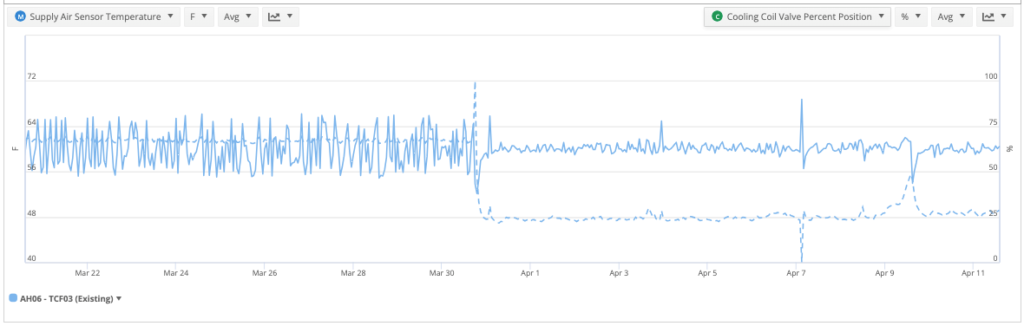
This was the one anomaly that needed on-site testing — a single, targeted FPT instead of blanket sampling.
One of the six fans was inoperable — flagged straight from the data. A work order fixed and confirmed it. Along the way, MelRok reconstructed the missing design: the unit carries 80% fan redundancy, enough to cover a single fan failure (1 of 6).
Air changes averaged over 32 ACH against ISO-8’s 10–25 ACH — the zones were being massively over-ventilated. MelRok recommended Testing, Adjusting & Balancing (TAB) to bring air changes down into the ISO-8 band.
saved versus the cost of traditional, on-site commissioning.
a single targeted FPT — every other anomaly’s root cause came from the data.
ISO-8 is within reach once TAB is performed; the client can then allocate the expansion zones for proper use.
The air handler’s design was reconstructed and handed to the client — 80% fan redundancy confirmed.
Right-sizing ventilation to ISO-8 is expected to cut air-handler energy by ~30%, to be measured via IPMVP after TAB.
WHAT IT MEANS
Measure the problem, then analyze the root cause. Most anomalies were resolved from data alone — no truck roll, no random sampling, just concrete action items.
Some root causes need a test. Where the data can’t isolate the cause, an FPT is still required — but limited to the flagged anomaly, not blanket 100% or random sampling.
By diagnosing from the EMIS first, MelRok produced a full commissioning report and action plan for a fraction of the cost of traditional commissioning — resolving both facility-improvement and energy-conservation measures on the air handler, and eliminating most of the manual FPT work that testing usually demands.
THE ANSWER
MelRok diagnosed an undocumented pharmaceutical air handler from the data — a failed actuator, a dead fan, and ISO-8 over-ventilation — and sent the client’s own staff a targeted action plan, with just one on-site test.