
A peak-load study turned an oversized, short-cycling pharmaceutical chiller plant into a right-sized, resilient one — 16,639 data points distilled into a single, confident capital recommendation.
THE SITUATION
A pharmaceutical facility depends on a robust HVAC system for year-round climate control. Its chilling infrastructure had drifted into inefficiency, and the client wanted data — not guesswork — to improve reliability and cut energy waste.
The question underneath it all: was the plant actually sized for how the building runs?
Cooling the plant can’t go down — in any season.
Equipment scaled for a peak that rarely arrives.
The client wanted evidence before spending on upgrades.
In non-peak months, oversized chillers cycled on and off constantly — driving wear, higher maintenance, and poor efficiency.
Without precise load numbers, the plant couldn’t be right-sized — risking underperformance at peak and strain at low load.
With no view of peak vs. average load, upgrades and optimization were guesswork — an expensive way to make capital decisions.
THE SOLUTION
MelRok computed instantaneous plant load across the full EMIS time series — turning three live sensor streams into one load signal.
INPUTS — live sensor streams
GPM
°F (CHWST)
°F (CHWRT)
Load (tons) = 500 × CHWSF × ( CHWRT − CHWST ) / 12,000
16,639 data points processed into mean, minimum, maximum, and percentile load distributions — led by MelRok’s lead mechanical / design engineer and delivered as a detailed report.
Off-peak, the pony chiller (Chiller_03, blue) modulates smoothly at low compressor power, following the load. Run the same period on the large units instead and the cost is obvious: Chiller_01 (green) draws high, steady power, while Chiller_02 (black) spikes on and off — the short cycling the study set out to fix.
mean load (typical 200–270)
peak ( >640 t for ~3 hrs )
of time above 600 t (355 pts)
95th-percentile load band
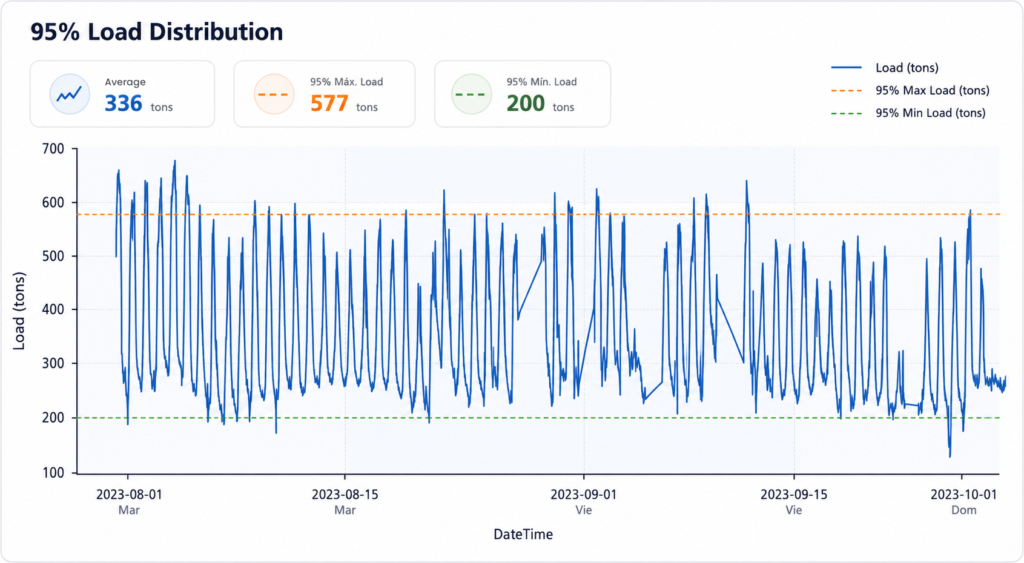
Plant load over time (blue), bounded by the 95th-percentile band — 200 t (min) to 580 t (max). Daily demand cycles well below the rare peaks.
THE RECOMMENDATION
A pharmaceutical facility depends on a robust HVAC system for year-round climate control. Its chilling infrastructure had drifted into inefficiency, and the client wanted data — not guesswork — to improve reliability and cut energy waste.
The question underneath it all: was the plant actually sized for how the building runs?
The data told a clear story: the plant lives at modest load — typically 200–270 tons, and under 580 tons 95% of the time. Loads above 600 tons are rare, brief spikes.
So the everyday load doesn’t need a giant chiller. A small, modulating “pony” chiller can carry it efficiently — with the existing large chillers held in reserve for the rare peak.
Deploy a 240-ton pony chiller
THE EVIDENCE
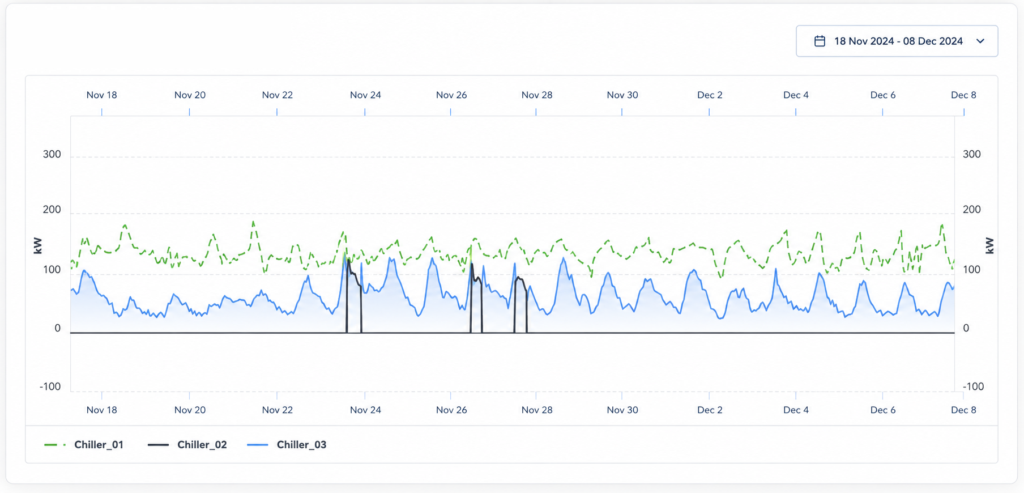
Off-peak, the pony chiller (Chiller_03, blue) modulates smoothly at low compressor power, following the load.
Run the same period on the large units instead and the cost is obvious:
Chiller_01 (green) draws high, steady power, while
Chiller_02 (black) spikes on and off — the short
cycling the study set out to fix.
Same load, far less energy — and no short-cycling spikes. That’s the recommendation, validated in the data.
THE SOLUTION
MelRok computed instantaneous plant load across the full EMIS time series — turning three live sensor streams into one load signal.
Better-matched sizing minimizes inefficient on-off cycles — extending
equipment lifespan.
Lower off-peak compressor power, with utility-cost savings expected as operations track real demand.
Redundancy covers rare peaks like the 688-ton event — without leaning on oversized units.
Hard metrics let the client make capital decisions with evidence, not guesswork.
THE TAKEAWAY