
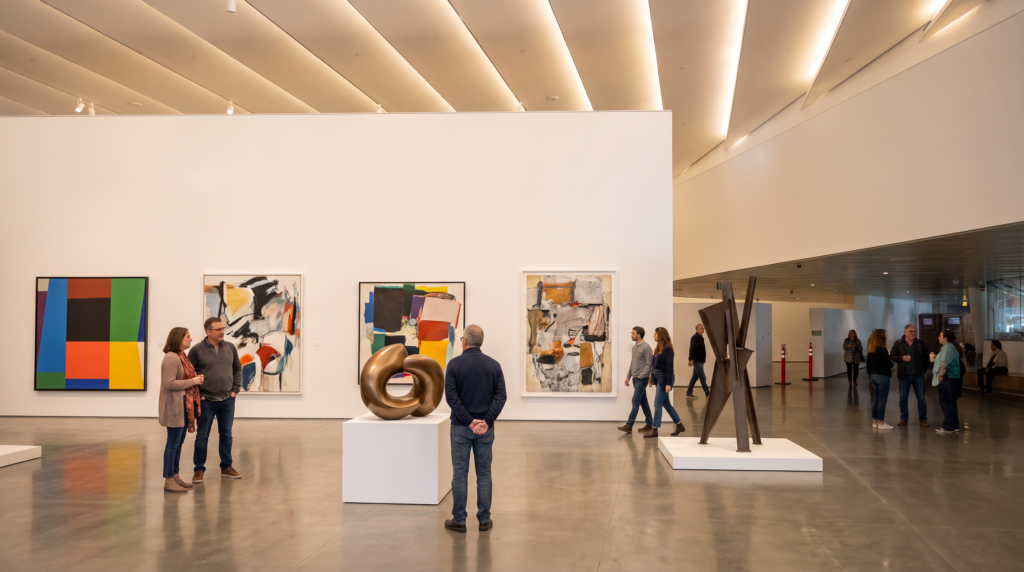
THE SITUATION
The central plant and the gallery air handlers exist for one purpose: to hold Class A and Class B rated spaces at 70–74 °F and 45–55 % RH, continuously. Equipment that meets its own setpoints while the galleries drift has not done its job.
On 3 April 2023, at around 20:50, temperature and relative humidity dropped abruptly across every gallery zone at once. Nothing in the building was in alarm.
An abrupt drop across all gallery zones
Not one VAV held 90 % of its data inside deadband.
Class A spaces hold the permanent collection and works on loan.
Nobody could say how well the space held Without deadband and psychrometric scoring, "the galleries feel fine" is the only available answer.
The box could not hold minimum flow VAV2-14’s damper actuating between 25 % and 100 % with its airflow setpoint at minimum.
Closed did not mean closed Discharge temperature more than 5 °F above the air handler’s supply air, at a 0 % reheat command.
The override nobody closed out Demand control ventilation held every box at maximum airflow after CO₂ returned to baseline.
Nobody could say how well the space held
Design intent for these galleries is specific: 70–74 °F and 45–55 % relative humidity, with a widely used acceptance criterion that at least 90 % of a zone’s data sit inside the deadband. Measured against that criterion in April 2023, not one VAV at the museum passed — on relative humidity or on temperature. VAV2-14, serving the mezzanine, was furthest out on both. Plotted as humidity ratio on an ASHRAE psychrometric chart against a 21–23 °C, 45–55 % RH envelope, the overwhelming majority of TSTAT2_14’s points fell outside the design-intent zone entirely.
FAILURE MODES
Bottom line: unmeasured intent is unmet intent
The box could not hold minimum flow
VAV2-14’s airflow generally followed its setpoint, but the damper command actuated between 25 % and 100 % whenever the airflow setpoint sat at minimum — a loop unable to settle at the low end of its range. Instability at the box is not a local problem: a damper cycling against a supply duct pulls the air handler’s fan speed and static pressure around with it, which is exactly what AHU2’s supply fan was doing. The recommendation was correspondingly narrow and testable: tune the damper control PID loop, and test damper control specifically at minimum airflow setpoint.
FAILURE MODES
Bottom line: the box could not hold minimum
FAILURE DOMAIN 03
Closed did not mean closed
With the reheat coil commanded to 0 %, VAV2-14’s discharge temperature ran more than 5 °F above AHU2’s supply air temperature. A fully closed valve should leave discharge air close to what the air handler delivers, so the delta points at the actuator, the valve, or the controller output itself. Because those three are distinguishable by test, the finding was written as one: measure controller voltage output, actuator position and valve position at 0, 15, 30, 45, 50, 65, 80, 95 and 100 % reheat command, and see exactly where the chain breaks.
FAILURE MODES
Bottom line: the valve was leaking through
THE SOLUTION
Score the space against its design intent — continuously, and in the space’s own units.
Every zone is scored on the share of its temperature and relative humidity data sitting inside the design deadband, against the 90 % acceptance criterion — one number that says whether the space held.
Zone temperature and relative humidity are converted to humidity ratio and plotted against the ASHRAE envelope, so every excursion is a visible point outside design intent rather than a complaint.
Damper stability, airflow tracking and reheat leak-by are evaluated per VAV, isolating a zone fault from an air handler fault before anyone opens a ceiling.
VAV sequence rules and demand control ventilation behaviour are verified against the written SOO, so a point left in override surfaces in days rather than seasons.
ROOT-CAUSE ISOLATION
Every gallery zone dropped at once. Three candidate causes were tested against the data before a cause was named.
VAV2-02 serves the loading dock, and an open dock would pull its zone toward ambient. Its temperature did not drop dramatically. Ruled out.
The safeguard closing outside air dampers under extreme ambient conditions was confirmed operating, with the minimum outside air damper closing as designed.
The AHU1 humidifier registered a refill fault the same day and its humidity output collapsed, with supply dewpoint on both AHUs already short.
Result: a humidifier failure and a supply dewpoint that could not reach setpoint, coinciding with an extreme low outside-air humidity event. Three contributing causes, named from the data, on the day it happened.
WHAT CONTINUOUS COMMISSIONING CAUGHT
The percent-in-deadband analysis turned "the galleries feel about right" into a measured fact: not one VAV held 90 % of its data inside the temperature or relative humidity deadband.
More than 5 °F of unexplained discharge temperature at a fully closed reheat command — a fault with no alarm attached, isolated to three separately testable components.
Demand control ventilation that raised airflow correctly and then never came back down, spending full-rate conditioned air against a baseline CO₂ level.
The space is where design intent is proven — or quietly lost.
THE RESULT
BEFORE
gallery VAVs met the 90 % in-deadband acceptance criterion — on relative humidity or on temperature. VAV2-14 sat almost entirely outside the design-intent envelope.
AFTER
gallery VAVs within the 45–55 % RH deadband. Only three remained outside the temperature deadband, each close to the 10 % acceptance criterion.
VAV2-14 humidity-ratio points beyond the too-hot / too-cold limits after correction.
VAV humidification sequence rules executing as written, having previously failed both.
Gallery relative humidity medians sitting near 50 % across the verification week.
THE REAL VALUE
A gallery held inside Class A tolerance means the fault stays a maintenance ticket — not a conservation incident, a loan-agreement problem, or an emergency call-out.
Ventilation that resets instead of pinning at maximum, and boxes that hold minimum flow instead of hunting, both stop spending conditioned air on nothing.
Zone faults arrived already separated from air handler faults, with a named component and a test attached — instead of a ceiling to open and a season to wait.
THE OBJECTIVE, DELIVERED
Continuous, design-intent-based diagnostics and monitoring-based commissioning — engineer-backed, with high-resolution IoT data and an AI-powered cloud on one platform. Monthly commissioning reviews and on-demand reporting included.