How turnkey connected commissioning brought a healthcare central utility plant back within its commissioning acceptance criteria — and converted static setpoints to dynamic ones that track design intent.
THE SITUATION
A healthcare central utility plant — chillers with condenser-water and chilled-water loops — supplies the cooling that clinical and critical spaces depend on. It was operating, but its key parameters were not holding setpoint. Worse, setpoints were static, so the plant was not tracking design intent as load changed. In a hospital that is not an abstract problem: an unstable chilled-water supply propagates downstream into the temperature and humidity control of the spaces it serves.
Stable chilled water is what lets downstream AHUs hold space temp and humidity.
Fixed setpoints can’t follow changing load the way the design assumed.
Every excursion is a nuisance alert today and a risk to conditions tomorrow.
THE CHALLENGE
Connected commissioning holds the plant to explicit, statistical acceptance criteria. On arrival, it was failing them.
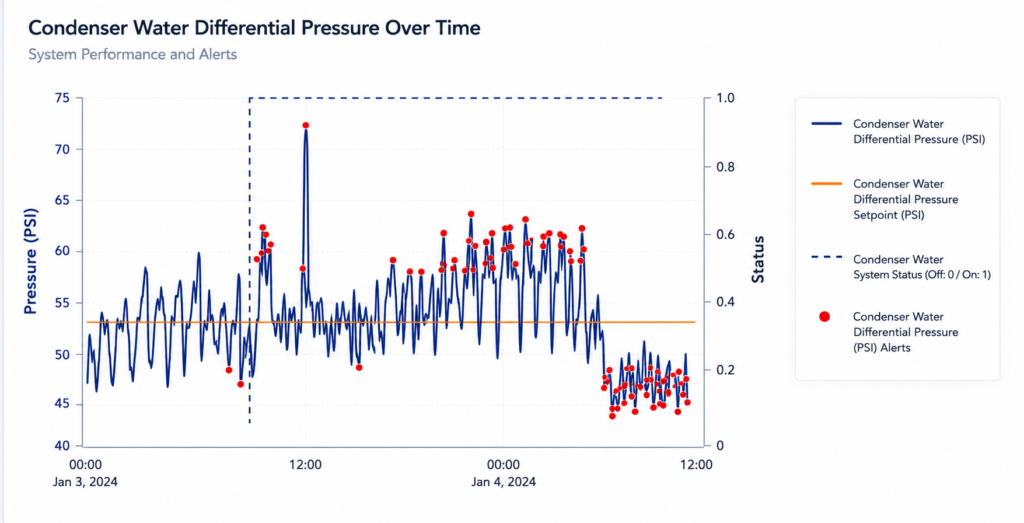
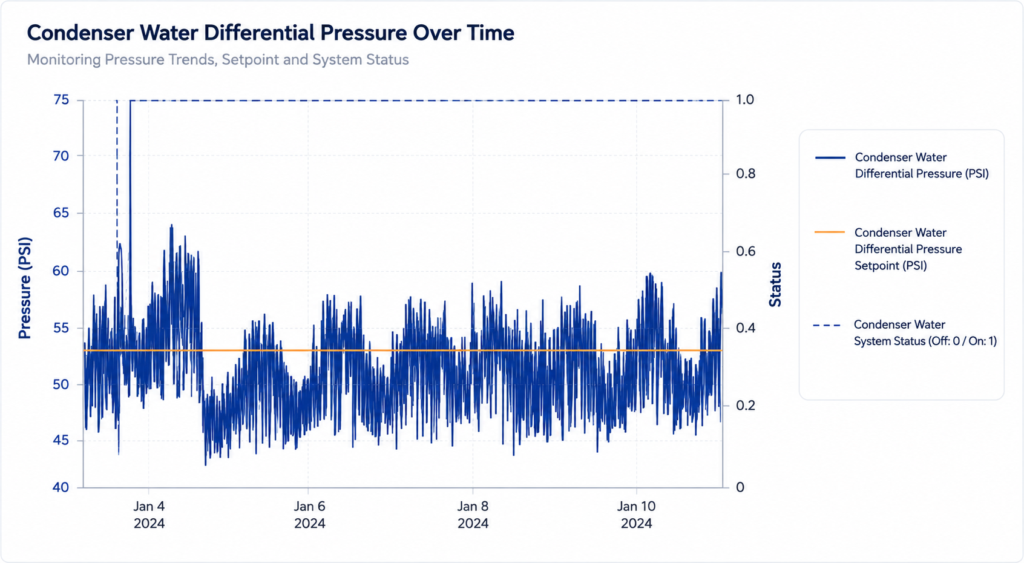
Criterion: ≥ 95% of observations within ± 4 psi of setpoint
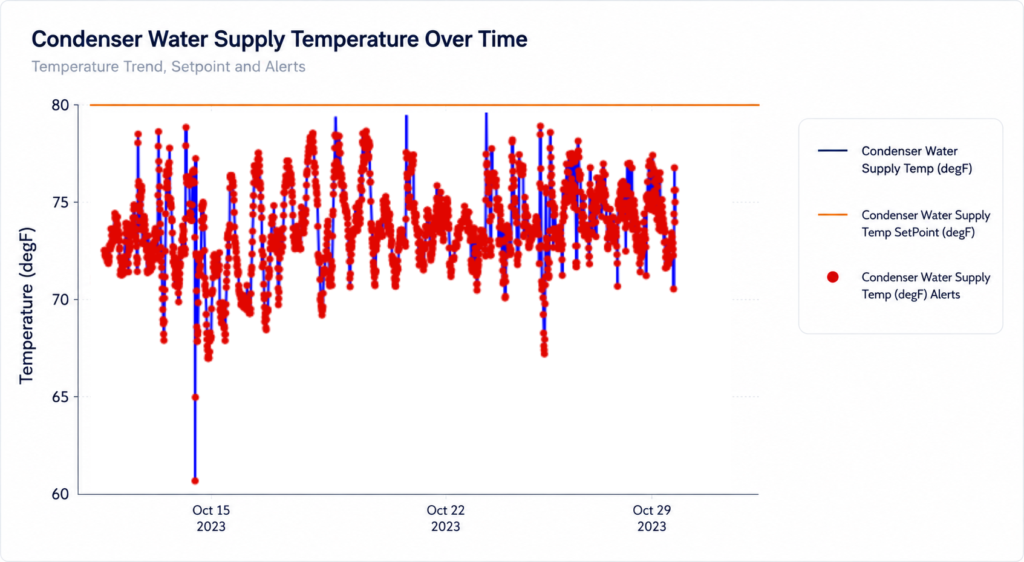
Criterion: ≥ 90% of observations within ± 2 °F of setpoint
ON ARRIVAL
of condenser-water differential-pressure readings were out of band — against a limit of just 5%.
Continuously trend every controlled parameter against its acceptance criterion, so “in control” is measured, not assumed.
Isolate the parameters violating their bands — condenser-water pressure and both water temperatures — and find why.
Bring temperature and pressure to setpoint and replace static setpoints with dynamic ones that track design intent as load changes.
Classified as a FIM — a Facility Improvement Measure (meeting design intent). No energy conservation measure (ECM) was claimed.
MelRok computed instantaneous plant load across the full EMIS time series — turning three live sensor streams into one load signal.
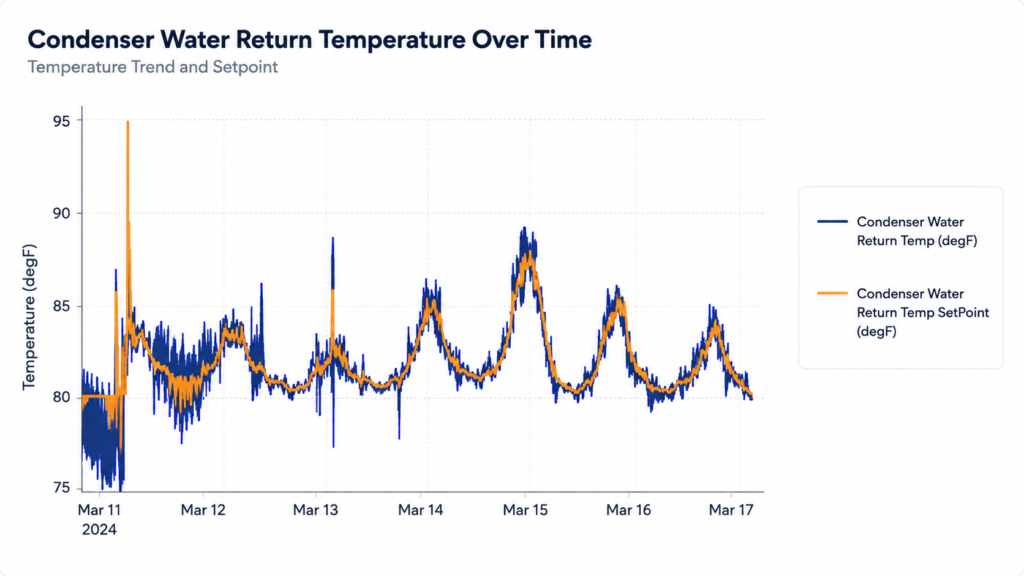
Acceptance criterion: ≥ 90% of observations within ± 2 °F of setpoint
Result: Pressure that had wandered out of band ~30% of the time — with a mid-window system trip — now holds tightly within ± 4 psi of setpoint. Alerts cleared.
RESULT 02
Result: A flat, static setpoint the plant never tracked was replaced with a dynamic setpoint — and measured temperature now follows it closely instead of scattering across a 15 °F range.
RESULT 03
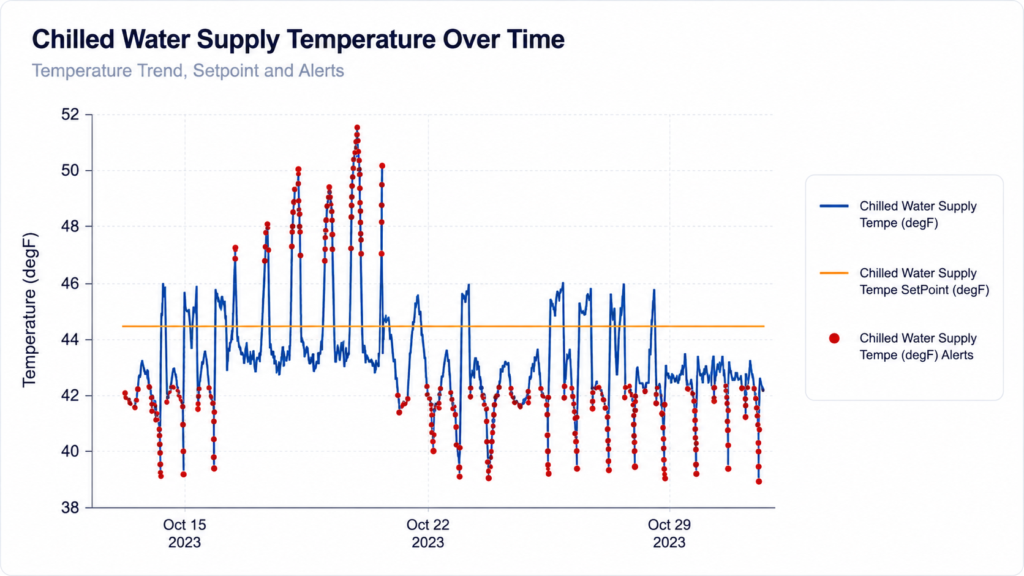
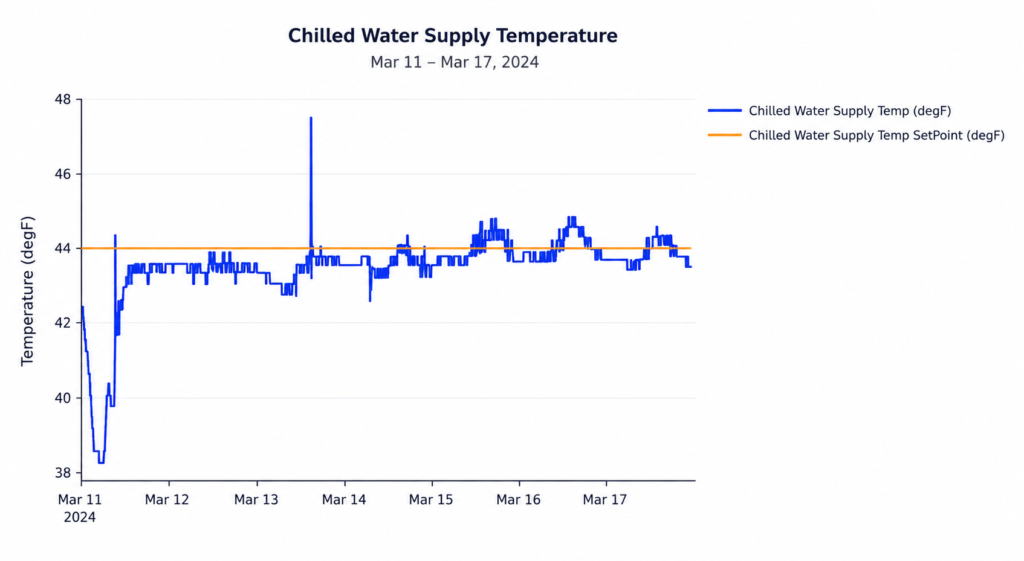
Acceptance criterion: ≥ 90% of observations within ± 2 °F of setpoint
Result: Chilled-water supply that had swung roughly 38–51 °F now holds within a tight band around its 44 °F setpoint — the stable supply downstream clinical spaces depend on. Alerts cleared.
WHAT IT MEANS
Meeting design intent. Temperature and pressure brought to setpoint, and static setpoints converted to dynamic setpoints that track design intent as load changes.
None claimed. This engagement was about control quality and design-intent conformance — no energy-savings figure is attributed to it. What it removes is a whole class of upstream excursions.
The central plant sits upstream of every clinical and critical space. A stable, on-setpoint chilled-water supply is the foundation downstream AHUs rely on to hold space temperature and humidity. Bringing the plant into control removes upstream excursions before they can propagate — and keeps it there, continuously.
THE OUTCOME
Turnkey connected commissioning brought a healthcare central plant back within its acceptance criteria and kept it there — monitoring-based commissioning verifies the plant stays in control, with monthly reviews and on-demand reporting.